Montenegro is implementing the CRS (Common Reporting Standard) – an international standard for the automatic exchange of financial account information for tax purposes.
CRS was developed by the OECD to enable the tax authorities of participating jurisdictions to receive information about financial accounts held by their tax residents in other jurisdictions. Montenegro is a signatory to the Multilateral Competent Authority Agreement on Automatic Exchange of Financial Account Information.
As a reporting financial institution, Zapad Banka is required to apply the prescribed rules for identifying and verifying its customers and their financial accounts and, when the legal requirements are met, to provide the required information to the Tax Administration of Montenegro.
In addition to CRS, the Bank continues to apply FATCA (Foreign Account Tax Compliance Act) rules concerning the identification and reporting of certain accounts connected to the United States of America. Montenegro applies FATCA based on a Model 1 intergovernmental agreement with the United States of America.
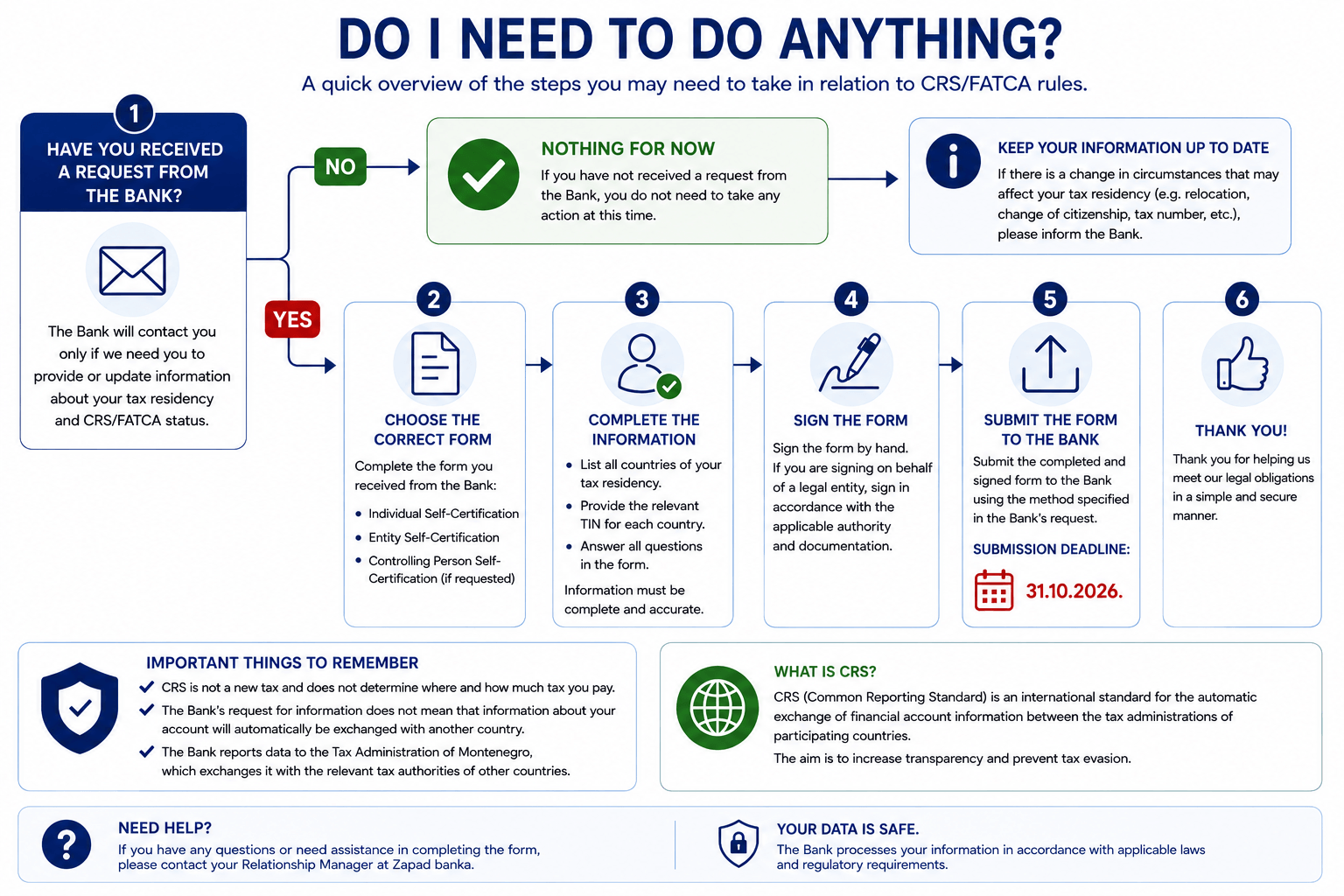
Pursuant to CRS/FATCA rules, the Bank must identify and record its customers’ tax residency and, for legal entities, their relevant CRS/FATCA status. For this reason, the Bank may ask you to complete a Self-Certification Form (Tax Residency Declaration) and, when necessary, provide additional information or documents.
If you are required to submit or update your information, the Bank will contact you and provide clear instructions. A request to complete the form does not automatically mean that your account is reportable or that you have a tax obligation in another country.
Tax residency identifies the jurisdiction or jurisdictions in which an individual or entity is considered a tax resident under their tax laws.
Tax residency is different from citizenship, place of birth, or the right to reside. For example, a Ukrainian citizen who lives and works in Montenegro may, depending on the specific circumstances and applicable tax laws, be a tax resident of Montenegro, Ukraine, both countries, and another country.
An individual may have more than one tax residency. The Bank does not establish a customer’s tax residency on their behalf. If you are unsure of your tax residency, we recommend checking the rules of the relevant tax authorities or consulting a tax advisor.
No.
Holding a passport of a particular country is usually not sufficient to determine tax residency.
When determining tax residency, factors such as permanent place of residence, length of stay, place of employment or business activity, center of vital and economic interests, and other criteria prescribed by the legislation of the relevant country may be considered.
There is a specific rule for the United States of America: U.S. citizenship is directly relevant for FATCA, therefore, information regarding U.S. citizenship must be provided to the Bank when applicable.
A Self-Certification is a declaration by which a customer provides the Bank with the information required to identify their tax residency and CRS/FATCA status.
Depending on the type of customer, different forms are used:
Individual CRS/FATCA Self-Certification – for individuals who are account holders;
Entity CRS/FATCA Self-Certification – for legal entities and other entities that are account holders;
Controlling Person Self-Certification – when it is necessary to identify the tax residency and status of a Controlling Person of a particular entity.
The customer is responsible for the completeness and accuracy of the information provided in the form.
TIN (Tax Identification Number) is a tax identification number assigned to a taxpayer by a particular country. If you are a tax resident of more than one country, the Self-Certification form should include each tax residency jurisdiction and the corresponding TIN for each, except when applicable rules permit a TIN not to be provided.
The Bank may request, among other things:
For companies and other entities, in addition to tax residency and TIN, the Bank must also determine their CRS/FATCA classification.
For CRS purposes, an entity may be, among other things, classified as:
Financial Institution,
Active NFE (Active Non-Financial Entity), or
Passive NFE (Passive Non-Financial Entity).
For a Passive NFE, the Bank must, when applicable, also identify the tax residency of its Controlling Persons. For this reason, the Bank may request an additional Self-Certification form from the Controlling Person.
No.
This depends on the company’s tax residency and CRS status, the type of account, and, in the case of certain Passive NFEs, the tax residency of their Controlling Persons. The Bank determines the classification based on the applicable CRS rules and the information and documentation available to it.
If an account meets the reporting requirements, the information may include details about the account holder, their tax residency and TIN, account details and the account balance or value, as well as certain financial amounts, depending on the type of account
In the case of a Passive NFE with a Controlling Person who is a Reportable Person, the prescribed information about the relevant Controlling Person will also be reported.
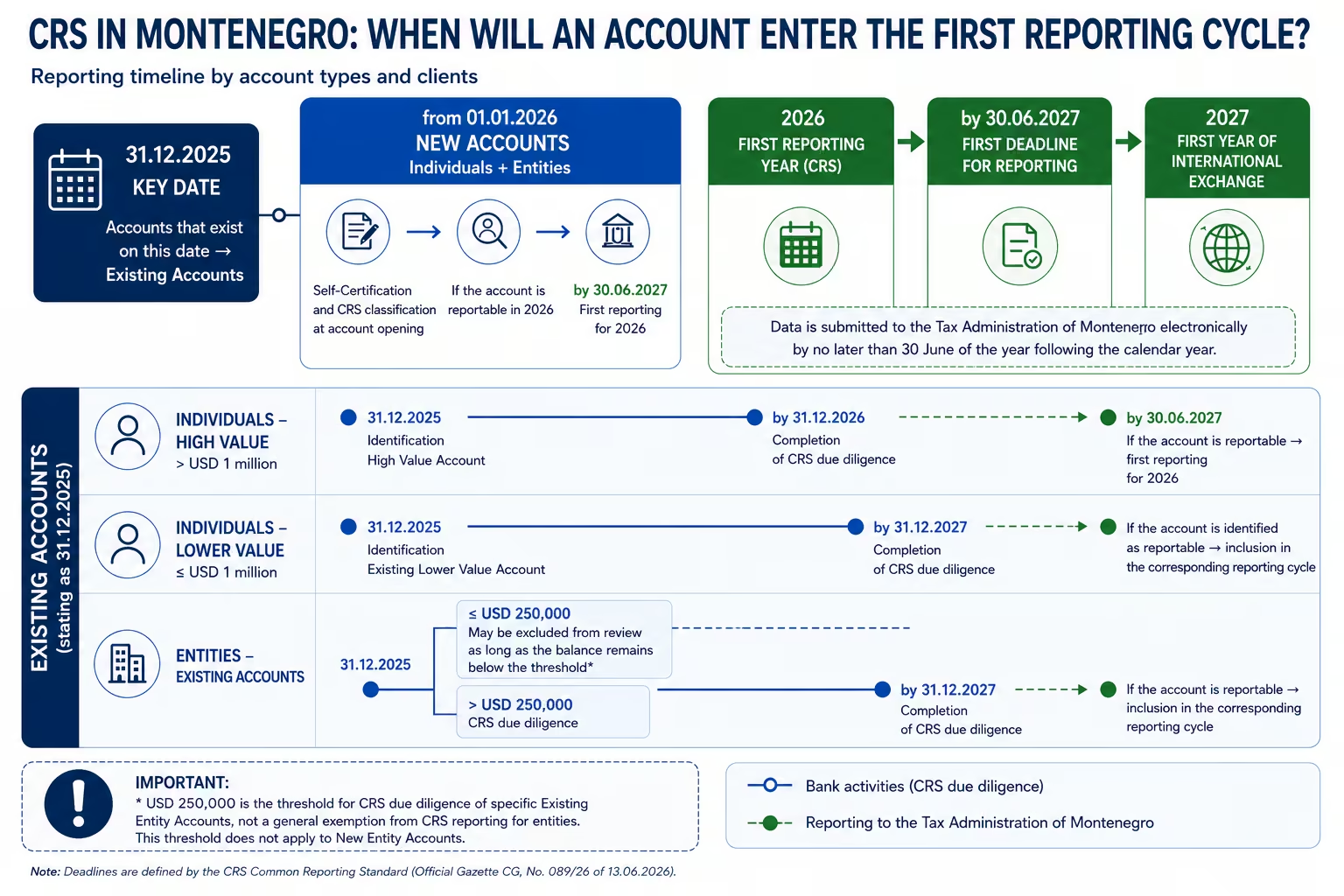
Reporting financial institutions in Montenegro submit the information electronically to the Tax Administration of Montenegro once a year, no later than 30 June for the preceding calendar year.
No.
Zapad Banka provides the information to the Tax Administration of Montenegro in accordance with applicable regulations. The international exchange of information is afterwards carried out between the competent tax authorities of jurisdictions meeting the conditions for CRS exchange.
No.
CRS is a framework for the automatic exchange of information, not a new tax.
CRS by itself does not establish whether you have a tax obligation, in which jurisdiction you are subject to tax, or how much tax you should pay. These matters are established by the tax laws of the relevant jurisdictions and, when applicable, international agreements for the avoidance of double taxation.
If, after submitting a Self-Certification form, a change occurs that could affect your tax residency or CRS/FATCA status, you should notify the Bank of the change.
This may include, for example, moving to another country, a change in tax residency or TIN, or, in the case of companies, a change in the ownership structure, Controlling Persons, or other circumstances relevant to CRS/FATCA classification.
In such cases, the Bank may request a new Self-Certification form or additional documentation.
If the Bank requests a Self-Certification form or additional documents from you, it is important that you provide them within the deadline specified in the Bank’s request.
Without the necessary information, the Bank may not be able to confirm your tax residency or CRS/FATCA status and will have to act in accordance with the rules applicable in cases when the required documentation is not obtained.
Please complete solely the form that corresponds to the request you received from the Bank.
Individual CRS/FATCA Self-Certification
For an individual who is the account holder.
Entity CRS/FATCA Self-Certification
For a company, legal entity, or other entity that is the account holder.
Controlling Person CRS/FATCA Self-Certification
For a Controlling Person if the Bank requests that they complete the form.
Zapad Banka provides information about the Bank’s CRS/FATCA obligations and instructions for completing its forms but does not provide tax or legal advice and does not establish a customer’s tax residency.
If you are unsure about your tax residency, TIN, tax obligations, or how the tax rules of a particular country apply to your circumstances, we recommend that you contact the relevant tax authority or an independent tax advisor.
For questions regarding the submission of forms and documentation, you may contact your dedicated account manager at Zapad Banka.
CRS/DAC2 – Tax Administration of Montenegro